
Kaylee Simons
Elmore Autauga News
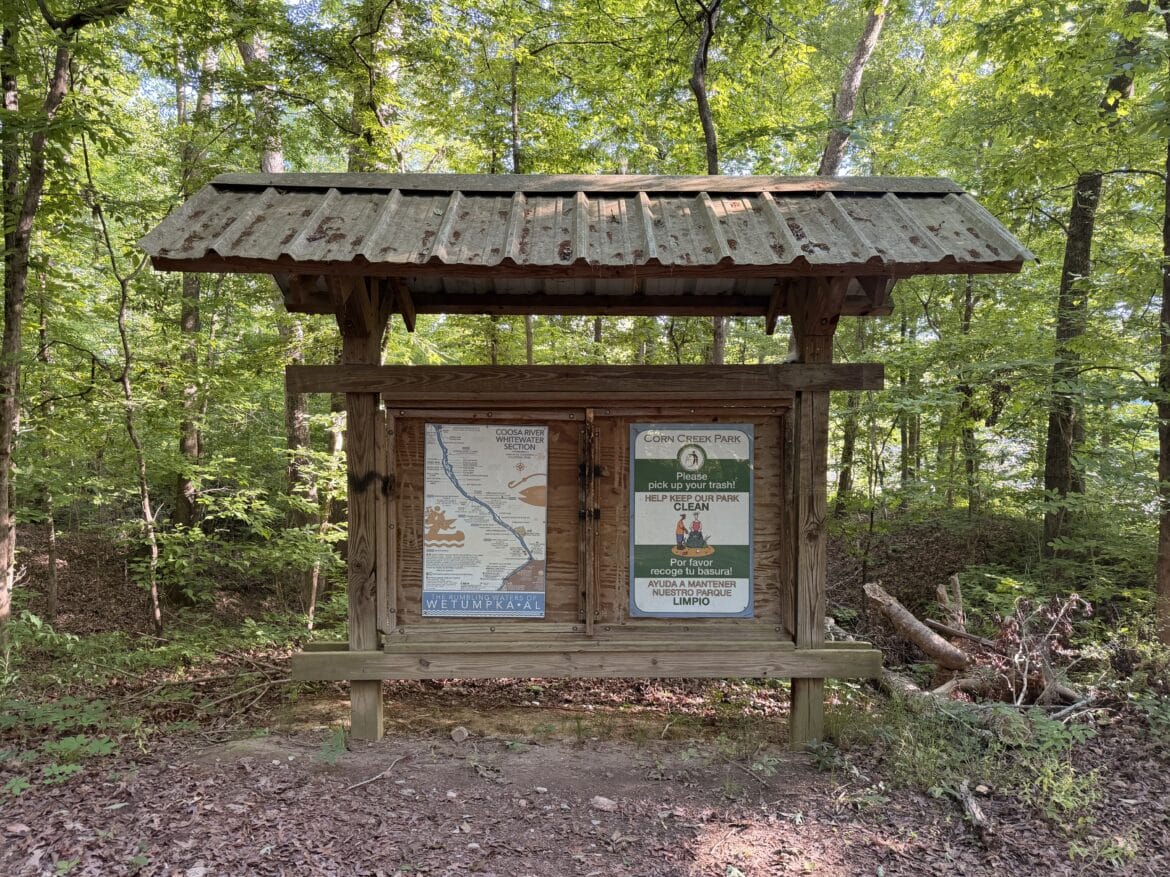
Tucked just off Highway 231, down a quiet gravel road across from Julia Tutwiler Prison for Women, Corn Creek Park feels like a place many pass without noticing. It is easy to miss and even easier to overlook. But for those who turn down that unassuming road, Corn Creek offers something rare in a growing River Region, a stretch of land where history, water and wilderness still move at their own pace.
Long before it became a quiet retreat for hikers and birdwatchers, the area surrounding Corn Creek was part of the historic heart of the Muscogee (Creek) Nation. The nearby confluence of the Coosa River and Tallapoosa River supported thriving Native communities who cultivated corn as a staple crop and gathered for ceremonies marking renewal and harvest.
Just to the south, Fort Toulouse-Fort Jackson State Historic Site stands as a reminder of the area’s colonial past. Established by the French in 1714, the outpost served as a key trading hub between European settlers and the Creek people, placing Corn Creek within a broader network of cultural exchange and early development.
By the early 20th century, the area had shifted again, shaped by infrastructure and industry. A concrete arch bridge built in 1929 carried Highway 14 over the creek and was later rehabilitated to preserve its historic character. Nearby, the once-feared “Devil’s Staircase” rapids at the mouth of the creek challenged early river navigation and influenced the eventual construction of dams along the Coosa.
Today, the urgency of those earlier eras has faded. What remains is a landscape defined by quiet movement. Water slipping over rock, wind moving through pine and hardwood and the occasional call of a hawk overhead.
Corn Creek Park spans more than a mile of wooded trails, weaving through mixed forest that opens and closes in pockets of shade and light. The path is not manicured, and in places it feels almost forgotten. That is part of its draw.
For birders, the park offers a surprising range of activity. Woodland species move through the trees, while the meeting point of the creek and river draws water birds and wading species. On clear days, visitors can scan the sky for birds of prey circling above the bluff line. The gravel road leading into the park has become its own corridor for wildlife observation, with quiet stretches that reward patience.
At the water’s edge, Corn Creek reveals one of its most recognizable features, a small waterfall and a long-standing local swimming hole where the creek spills into the Coosa River. In warmer months, families gather along the banks, kayaks drift nearby and the sounds of summer carry through the trees.
There is a rustic honesty to the space. It is not heavily maintained, and visitors are encouraged to be mindful of changing water conditions, strong currents and the impact of litter that can occasionally disrupt the natural setting. Corn Creek is also often confused with Burnt Corn Creek, the site of the 1813 Battle of Burnt Corn that marked the beginning of the Creek War. Despite the shared name, the two locations are separate in both geography and history.
In Wetumpka, Corn Creek tells a quieter story. It is a place where past and present exist side by side, where history lingers in the land, the water and the worn paths that continue to guide visitors through.
For those who have never made the turn off Highway 231, it may be worth the detour. Go early, when the light filters through the trees and the trails are still. Walk a little slower. Look up more often. Corn Creek is not a place that tries to stand out, but it is one people tend to remember.