
Carmen Rodgers
Elmore Autauga News
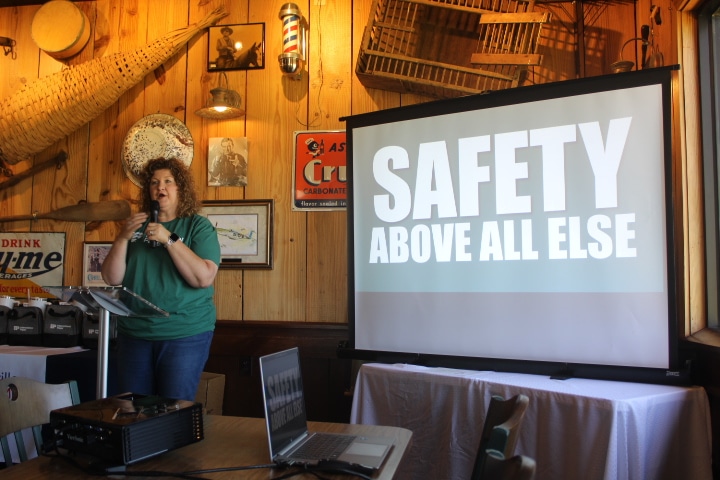
The Prattville Area Chamber of Commerce hosted the monthly Chamber Luncheon at The Catfish House on Wednesday, May 21.
This luncheon brought together local business leaders and community members to focus on the critical role mental health plays in workplace safety and overall well-being.
The luncheon was sponsored by International Paper and emphasized the importance of supporting employees’ mental and emotional health as a fundamental component of a safe and productive work environment.
In recognition of Mental Health Awareness Month, attendees heard from Cary Kuhlman, Executive Director of the Samaritan Counseling Center, which offers affordable, spiritually sensitive mental health care to individuals and families across the River Region.
Since its founding in 1999, the center has embraced a whole-person approach to counseling—addressing emotional, physical, and spiritual needs to promote lasting wellness and balance.
Kuhlman, who joined the Samaritan Counseling Center as Executive Director in 2016, shared thoughtful insights and practical strategies for incorporating mental health awareness into daily routines and professional settings.
“Our high mark, two years ago, was 13,000 counseling hours,” Kuhlman said. “We have been very active, and we have seen tremendous growth.”
The non-profit organization employs 17 counselors and five administrative staff members who operate the Samaritan Counseling Center’s Montgomery location.
His presentation underscored the value of fostering a workplace culture that encourages open conversations about mental health and provides resources for those who may be in need of mental health services.
“We are addressing the stigma around mental health,” Kuhlman said. “We haven’t erased it, yet, but we are eroding it, and we are doing a good job. People are coming forward to seek help.”
Kuhlman explained that the center’s mission is rooted in a wellness-focused philosophy.
“We do this through a wellness-oriented philosophy, emphasizing mind, body, spirit, and community,” he said.
“There is an emotional physical side in the workforce and this can influence performance, morale, and long-term employee retention,” Kuhlman explained.
Kuhlman said that 88% of the workers in this country feel like they work for an organization that doesn’t care about them.
Furthermore, how an employee feels in the workplace can affect home life.
“The way our team members are treated at work has a profound impact on the way they return home and treat their spouses and children,” he said as he explained a recent study conducted by the center.
Kuhlman offered three key strategies for transforming workplace culture: promote micro-rest breaks, support healthy boundaries, and create a safe space for open conversations about mental health.
Kuhlman also suggested taking a “no phone” lunch break.
“Take that time to unwind, and interact with colleagues,” he said. “Put the phones away and turn them off.”
Encouraging simple strategies to support mental well-being during the workday, Kuhlman offered a practical tip.
“Walk around the building. Let the fresh air clear your mind to get ready to go back and address the rest of the workday,” he explained.
Set your boundaries. Leave work at work and enjoy your time at home.
“Set boundaries for after-work emails and phone calls,” he explained. “As managers, we’re on 24/7. Well, if we are doing that to our employees, all that does is create more stress in the workplace because your employees are on 24/7 and maybe not getting paid to be on 24/7. Respect that time away from work. Don’t send emails and texts after hours, interrupting dinner or family time.”
Kuhlman brought up the idea of regret-free-PTO.
“Vacation and PTO are there for a reason. They are there for you to get away. To refresh. To recharge and then get back to the job afterward. Encourage your employees to take that time that is allocated so they can be better employees,” he said.
Kuhlman asked fellow business leaders to make the conversation around mental help stigma-free.
“Make mental health part of the dialog,” Kuhlman said. “Watch for things. Ask questions like, ‘Hey, are you ok’. Make that intervention. Is there more that we can do here as an employer to address the stress and anxiety in your life?”
Kuhlman also encouraged managers and business leaders to have an open-door policy.
“Open that door so an employee can be free to talk,” he said.
The correlation between well-being and workplace performance is undeniable. Creating an environment that prioritizes mental and emotional safety not only improves individual morale but also enhances team dynamics and overall organizational success.
“A physiologically safe workplace leads to stronger teams and better results,” Kuhlman said.